The short version
- A legal UK e-bike assists only while pedalling and cuts assistance by 15.5mph
- Motor support makes hills, headwinds and loaded journeys more manageable
- Range varies far more than a catalogue maximum suggests
- Weight, battery replacement and safe charging are the main ownership compromises
What is an electric e-bike?
An electric bicycle is a pedal cycle fitted with a motor, battery, controller and sensors that add assistance while the rider pedals. The rider still steers, balances, brakes and contributes effort; a road-legal UK electrically assisted pedal cycle is not an electric motorcycle disguised with pedals.
“E-bike”, “electric bike” and “electrically assisted pedal cycle” are often used interchangeably. The important distinction is legal configuration: a qualifying EAPC is treated like an ordinary pedal cycle in Great Britain, while a faster or more powerful machine may be classed as a motor vehicle.
The assistance changes the cost of difficult moments rather than eliminating cycling. Accelerating a loaded bike, climbing, riding into wind and restarting after junctions require less rider effort, but pedalling above the assistance cut-off feels much like moving a heavier conventional bicycle.
How pedal assistance works
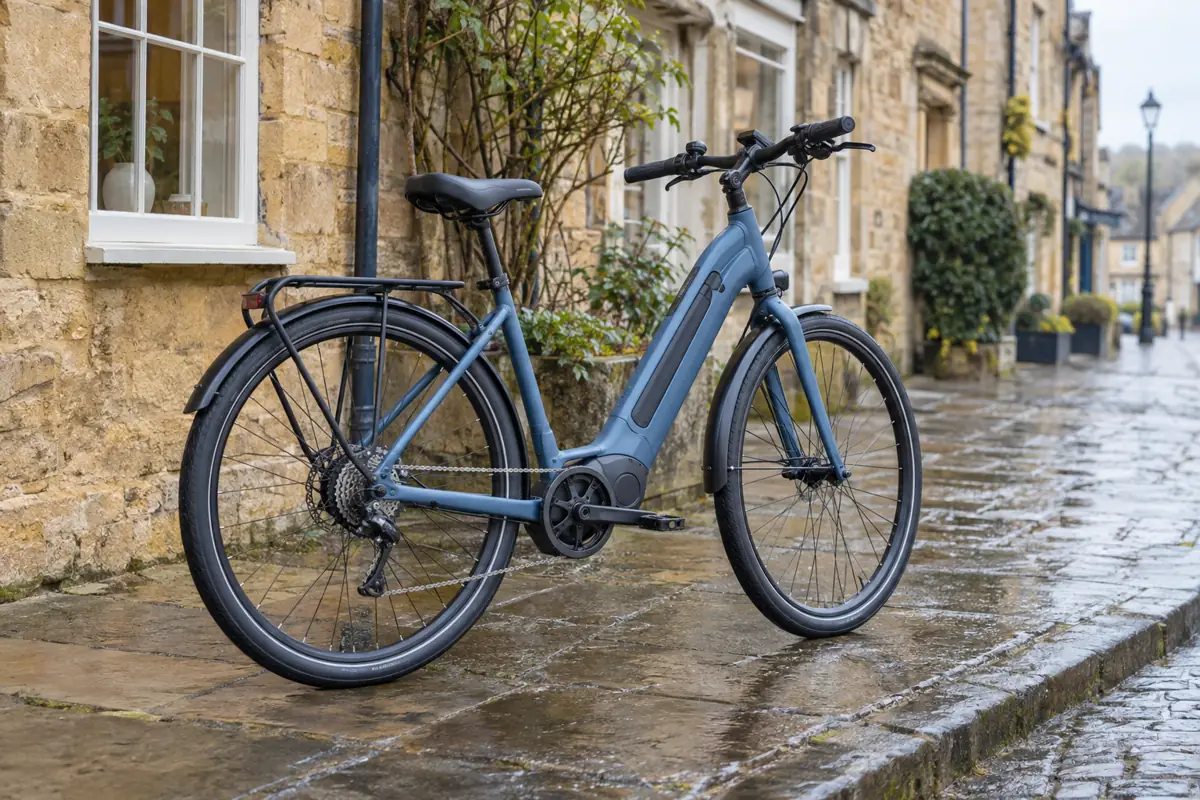
A sensor tells the controller that the rider is pedalling, and the controller releases energy from the battery to the motor. The assistance level selected at the display changes how strongly the system responds; Eco normally preserves energy, while higher modes support starts and gradients more forcefully.
Cadence sensors mainly detect that the cranks are turning. They can be affordable and effective, but assistance may feel delayed or surge-like because the system knows little about how hard the rider is pushing.
Torque sensors measure pedal force and can make support rise naturally with effort. They often feel more bicycle-like and can use energy efficiently, although calibration matters and a torque-sensor label alone does not guarantee a polished ride.
A front- or rear-hub motor drives one wheel independently of the bicycle’s gears. A mid-drive motor acts through the chain, belt and gears, which can be excellent on hills but increases drivetrain load and rewards smooth shifting.
UK electric-bike law
In Great Britain, a qualifying EAPC must have pedals that can propel it, show either battery voltage or maximum speed, and display the motor’s continuous rated power. The motor’s maximum continuous rated power must not exceed 250 watts and electrical assistance must cut off when the bike reaches 15.5mph.
The rider must be at least 14. A compliant EAPC does not need registration, vehicle tax, a driving licence or compulsory motor insurance, and it can generally use the same roads and cycle facilities as an ordinary bicycle.
A throttle has additional restrictions. Limited “walk assist” can help at low speed, but a machine that propels itself beyond permitted conditions without pedalling may need type approval and can become a moped or motorcycle in law.
Do not confuse peak electrical output in marketing with the legally relevant continuous rated power. If a seller cannot clearly explain the motor rating, assistance cut-off and conformity markings, do not assume the bike is road legal.
Northern Ireland’s rules have their own legislative history, and laws can change. Riders should use the current official guidance for the nation in which the bike will be used.
Types of e-bike
Urban and hybrid e-bikes use an upright or moderately forward position, practical tyres and fittings for mudguards or luggage. Lightweight city models are easier to lift and can feel lively, while fully equipped step-through bikes are accessible but often much heavier.
Electric mountain bikes use strong mid-drive motors, wide tyres, suspension and trail geometry. The motor helps on climbs, but the bike must still be suitable for the trail and ridden within local access rules.
Electric gravel and road bikes use narrower tyres, lighter systems and a sporty position. Their assistance is often subtle, preserving the feel of a performance bicycle while reducing the penalty of gradients and headwinds.
Folding e-bikes prioritise compact storage and multimodal travel. Check the folded dimensions and carry weight rather than assuming that a folding hinge makes a 20kg machine easy to take up station stairs.
Electric cargo bikes use long rear racks, large front boxes or extended frames to carry children or goods. They can replace some car journeys but require careful braking, loading, parking and low-speed handling practice.
Conversion kits add a motor and battery to an existing bicycle. Compatibility, braking, wheel strength, battery mounting, electrical safety and legal rating all matter; a poorly matched conversion can overload a frame or create a serious battery risk.
Benefits of an electric e-bike
The clearest benefit is consistency. Assistance can reduce the difference between an easy and difficult day, helping a rider tackle hills, headwinds, heavy shopping and repeated starts without arriving exhausted.
That can make cycling useful for longer journeys or for people returning after illness, managing a condition, rebuilding fitness or riding with a faster companion. It does not make every e-bike medically suitable, so anyone with health concerns should discuss exercise with an appropriate professional.
Research generally finds e-cycling to be moderate-intensity physical activity. Because riders may travel farther or ride more often than they would on a conventional bicycle, total activity can remain meaningful even when each kilometre requires less effort.
For commuting, a legal e-bike avoids fuel, parking and many fixed costs associated with a car. A removable battery can be charged indoors from an ordinary socket, and the bicycle can use cycle routes where permitted.
Utility is another benefit. A mid-drive cargo or trekking e-bike can make children, groceries or work equipment manageable without needing exceptional leg strength, provided the load is secure and within both rack and total limits.
Disadvantages and limitations
Weight is the most immediate drawback. Batteries, motors, stronger frames and equipment can push an e-bike well beyond 20kg; a bike that feels stable on the road may be impossible for one person to carry up stairs or onto a hanging rack.
Purchase price and depreciation are higher than for a simple pedal cycle. Batteries are expensive consumable components, electronics can be proprietary, and a discontinued display or controller may decide whether an otherwise sound bike remains repairable.
Range uncertainty requires planning. A strong headwind, winter temperature, climbing and high assistance can cut distance sharply, while an ageing battery gradually stores less energy.
Charging introduces a low-frequency but serious fire risk when batteries are damaged, counterfeit, badly repaired or used with an incompatible charger. Safe ownership needs more discipline than parking a mechanical bicycle and forgetting it.
Theft consequences are greater because the bike and battery are valuable. Integrated GPS can help recovery but does not physically secure the frame; a rated lock, sensible location and insurance may still be needed.
A heavy e-bike can also carry more momentum. Reliable brakes, appropriate tyres and smooth speed choice matter, especially in rain, on shared paths and when transporting a child or load.
Battery capacity, range and charging
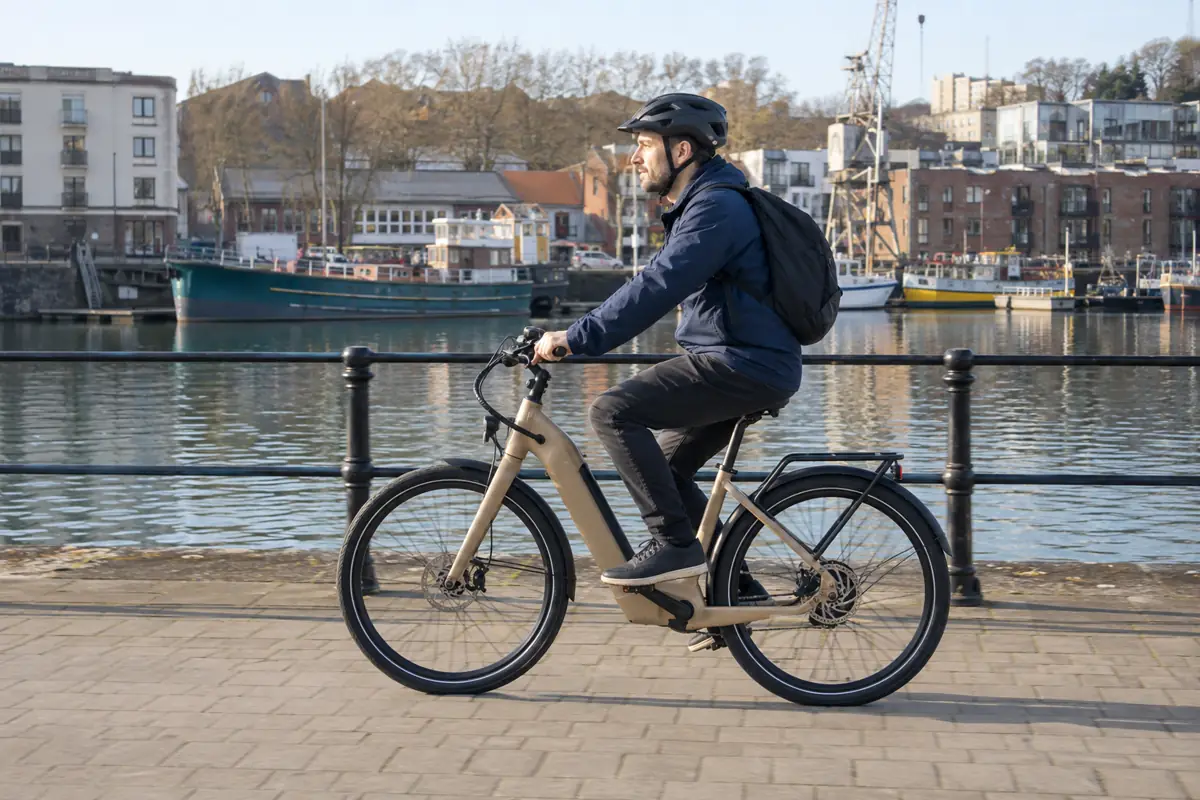
Battery capacity is expressed in watt-hours. A 500Wh pack contains roughly twice the nominal energy of a 250Wh pack, but that does not mean it always travels twice as far because bike weight, motor efficiency, tyres, speed, terrain and assistance can differ.
Catalogue ranges are usually produced in favourable conditions with a moderate rider load and low assistance. A credible comparison records battery watt-hours and the test assumptions; “up to” distance on its own is not enough.
Lithium-ion batteries age through time, charge cycles, heat and storage conditions. Avoid storing a battery fully empty, follow the maker’s long-term storage instructions, and keep it away from excessive heat or freezing conditions.
Use only the approved compatible charger. Charge on a stable non-combustible surface away from escape routes, avoid extension leads where the manufacturer warns against them, and do not charge while asleep or when nobody is present.
Allow a cold or hot battery to reach the permitted charging temperature. Never charge a pack that is cracked, swollen, leaking, has suffered a heavy impact or behaves unusually; isolate the area safely and contact the manufacturer or fire service as appropriate.
Batteries should not go into household waste. Use the seller, manufacturer or a suitable battery recycling route and follow transport rules, because large lithium-ion packs need specialist handling.
Motors, sensors, gears and brakes
Torque in newton-metres helps describe turning force, but more is not automatically better. A light 40Nm hub-motor bike can be pleasant on flat streets, while a loaded cargo bike on a steep hill may benefit from 75–85Nm and a low mechanical gear.
Mid-drives can exploit the bicycle’s gears, keeping the motor in an efficient cadence on hills. Shift down early and reduce pedal pressure during a change, because full motor torque across a strained chain can accelerate wear or produce a harsh shift.
Single-speed belt drives are clean, quiet and low maintenance, but one ratio cannot be ideal for starting, climbing and fast riding. Internal-gear hubs keep the drivetrain tidy and may allow stationary shifts, while derailleurs offer familiar serviceability and broad ranges at the cost of exposure and cleaning.
Hydraulic disc brakes are common because they provide strong control with modest hand force. Rotor size, pad compound, load, tyre grip and maintenance all affect stopping; no motor specification compensates for contaminated pads or underinflated tyres.
Safety, security and maintenance
Before every ride, check tyre pressure and damage, wheel security, both brakes, controls, lights and any luggage or child seat. Listen for new noises and stop if the frame, fork, battery mount or electrical wiring appears damaged.
Use a qualified mechanic for safety-critical work outside your competence. E-bike brake and drivetrain service is conventional in principle, but motor diagnostics, firmware, battery repair and proprietary wiring need the correct training and tools.
Lock through the frame to an immovable object with as little free space as practical. Use a second lock for valuable wheels, record the frame and battery serial numbers, keep proof of purchase and check the exact security standard required by an insurer.
Software locks, alarms and tracking are additional layers. They can deter or help locate a stolen bike, but batteries can flatten, radio coverage can fail and professional thieves can remove components.
Ride with extra stopping distance until the bike’s mass and assistance response feel familiar. Start in a lower support mode, especially on wet surfaces, crowded paths or loose corners.
Costs and environmental impact
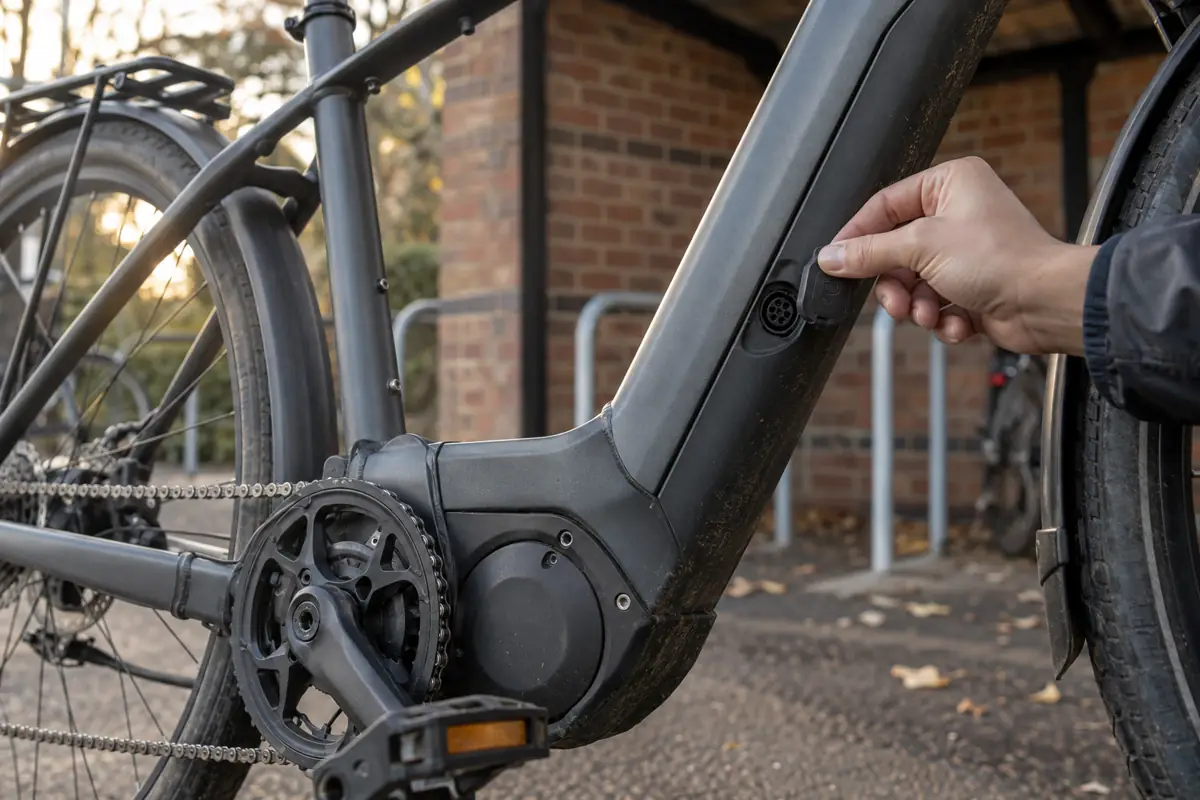
Budget beyond the sticker price. A secure lock, helmet, luggage, mudguards, initial setup, servicing, brake pads, tyres, drivetrain parts, insurance and eventually a battery can materially change ownership cost.
Electricity per charge is usually modest compared with car fuel, but calculate using the battery’s kilowatt-hours and the current tariff. Charging loss means the wall consumes a little more energy than the battery’s stated capacity.
An e-bike has more manufacturing impact than a simple bicycle because of its battery, motor and electronics. Its environmental case is strongest when it replaces car journeys and remains serviceable for many years, not when it displaces walking or a functioning conventional bicycle and is replaced quickly.
Choose replaceable batteries, documented parts and accessible servicing where possible. Keeping a bike in use, repairing wear items and recycling the battery responsibly are more meaningful than a vague “green” label.
How to choose the right e-bike
Write down the regular route, steepest gradient, round-trip distance, surface, carrying need, storage access and whether the bike must be lifted. These constraints quickly separate a light urban bike from a powerful trekking, cargo or folding design.
Test ride more than one motor system. Use low and high support, ride with the motor switched off, restart on a slope, brake firmly in a safe place and check low-speed steering.
- Confirm legal continuous motor rating and assistance cut-off.
- Compare battery watt-hours and replacement price, not only claimed range.
- Choose mechanical gearing that suits the steepest regular climb.
- Lift or wheel the bike through the real storage route.
- Check total permissible load, rack limit and child-seat compatibility.
- Ask who performs assembly, warranty diagnostics and future servicing.
- Confirm spare battery, display, charger and controller availability.
- Check frame fit, saddle range, reach, brake-lever access and tyre clearance.
Direct-to-consumer e-bikes can offer strong specifications, but savings disappear if assembly, returns or service are difficult. A local dealer can add value through fitting, a test ride and responsibility for the complete bike.
Frequently asked questions
Do you need a licence for an e-bike in the UK?
Not for a qualifying EAPC used by a rider aged 14 or over. A faster or more powerful machine that falls outside EAPC rules may need registration, licensing, insurance and an approved helmet.
Can an e-bike work without battery power?
Yes, if it is a conventional pedal-assist bicycle, but weight and motor or drivetrain drag can make it harder to pedal. Test this before buying if running out of charge would be a serious problem.
How long does an e-bike battery last?
There is no universal lifespan. Cell quality, temperature, storage, charge cycles, discharge depth and system management all matter, so check the maker’s capacity warranty and replacement availability.
Are e-bikes good exercise?
They can provide moderate physical activity and may enable longer or more frequent rides. The actual exercise depends on assistance level, route, rider input and how often the bike replaces passive travel.
Can you ride an e-bike in the rain?
Reputable systems are designed for normal outdoor use within their stated protection limits, but they are not necessarily waterproof against immersion or pressure washing. Follow the maker’s cleaning and storage instructions and inspect damaged seals or connectors.
Check current rules and safety advice
This guide uses official UK legal and battery-safety material, Cycling UK technical guidance and peer-reviewed research. Open the original sources for full detail.
- GOV.UK: electric-bike rules↗
- Department for Transport: EAPC information sheet↗
- Cycling UK: guide to electric bikes↗
- Cycling UK: electric cycles and the law↗
- Cycling UK: e-cycle batteries↗
- UK Government: battery safety for e-cycle users↗
- London Fire Brigade: safe charging↗
- Systematic review of e-cycling and physical activity↗