The short version
- Four-inch tyres improve cushioning and loose-surface grip but reduce efficiency
- Many current models weigh 30–48kg, even when they fold
- Hydraulic brakes are worth prioritising on the heaviest bikes
- For mainly paved commuting, a lighter e-bike with 2-inch tyres is usually the better choice
| Format | Best for | Check first |
|---|---|---|
| 20-inch folder | Compact ground-level storage | Real carry weight and folded size |
| 26-inch fat bike | Full-size rough-surface leisure riding | Frame fit, steering effort and transport length |
| Step-through utility | Errands and easier mounting | Total and rack load limits |
| Full-suspension cruiser | Comfort-led mixed-surface riding | Weight, brake quality and pivot servicing |
What fat tyres change
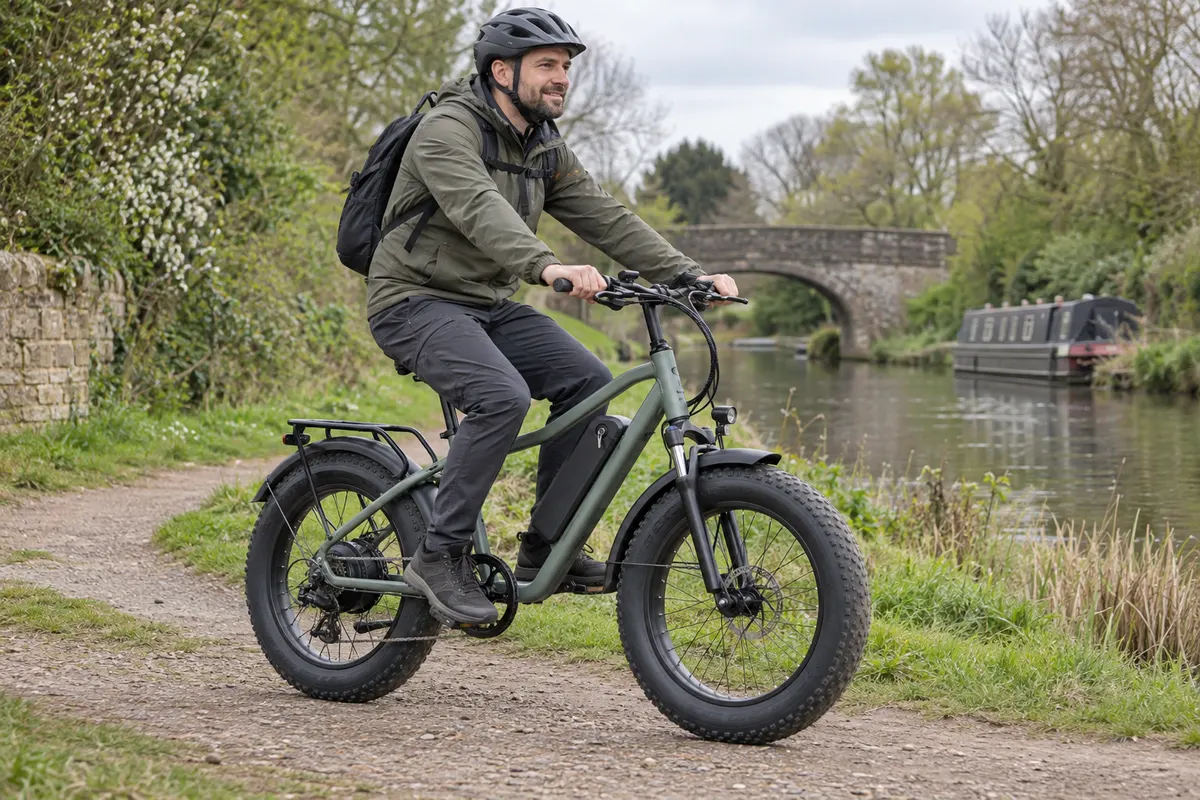
A fat-tyre e-bike combines a motor and battery with tyres commonly around four inches wide. The contact patch can add cushioning, flotation and low-speed confidence on loose ground, while the motor masks some of the extra rolling resistance.
The motor does not remove the physics. Wide tyres, reinforced frames and large batteries create more inertia under braking and in tight turns. When assistance stops at 15.5mph—or the battery is empty—the same bicycle can feel slow and demanding.
Do not confuse fat-bike appearance with mountain-bike capability. Tyre compound, geometry, suspension control, wheel strength and brakes determine whether a bike can handle rough terrain safely.
20-inch or 26-inch?
Twenty-inch fat wheels keep the frame compact and are common on folding, step-through and moped-shaped bikes. The deep tyre brings the outside diameter closer to a larger conventional wheel, but steering remains relatively quick and the short chassis can feel busy on broken ground.
Twenty-six-inch fat wheels roll more calmly through holes and loose surfaces. They also create a long, bulky bicycle that can be difficult in narrow storage and unsuitable for many vehicle racks.
The familiar size label is incomplete. Confirm the full tyre marking and whether replacements are available in Britain; 20×4.0 and 20×4.5 tyres are not interchangeable in every frame or rim.
Weight, folding and transport
Folding reduces the storage footprint; it does not make a 33kg bicycle portable. A fat-tyre folder may fit a hallway, camper or large boot while remaining unsuitable for stairs, busy trains or a platform change.
Check the complete bike weight with battery, rack, baskets and accessories. Then compare it with the per-bike limit of a car rack, the lifting route into storage and the capacity of any workshop stand.
If a lift, stair or train is part of the weekly routine, practise with a bicycle of similar mass before ordering. A narrower-tyred folder can save 8–15kg and may complete the journey more reliably.
Motor, battery and realistic range
A UK electrically assisted pedal cycle may use a motor with a maximum continuous rated power of 250W. Torque claims can help describe low-speed support, but controller calibration, gearing, sensor type, total mass and traction decide what the rider actually feels.
Battery capacity in watt-hours is more useful than a distance headline. Four-inch tyres, cold weather, hills, high assistance and heavy loads all consume energy. Treat an “up to” range as a favourable test result, not a guaranteed return journey.
Large packs can exceed 1,000Wh and take many hours to charge. Obtain the exact replacement price and approved charger, follow the maker's instructions and charge away from escape routes while present.
UK legal checks
In Great Britain, a qualifying electrically assisted pedal cycle must have pedals that can propel it, use a motor whose maximum continuous rated power does not exceed 250W and cut electrical assistance by 15.5mph. The rider must be at least 14.
A throttle can change classification. A permitted low-speed walk-assist function is different from a control that propels the bike at normal riding speed without pedalling. Display limits, a CE statement or a 250W line do not resolve contradictory controller modes.
Check the exact delivered bicycle. Model names are reused across countries, and overseas videos may show power or speed modes that do not describe a legal UK configuration.
Brakes, tyres and maintenance
Hydraulic disc brakes reduce lever effort and are worth prioritising as bike and cargo weight rise. Mechanical discs can work well when properly sized, centred and bedded in, but need more frequent cable adjustment.
Wide tyres need accurate pressure and can be expensive to replace. Confirm the casing, tube and rim-tape sizes before buying the bike, and ask a local workshop whether it will remove a heavy rear hub-motor wheel.
Folding joints, suspension pivots, battery locks and cable routes add inspection points. After boxed delivery, arrange a safety check of wheel security, brakes, drivetrain, hinges, controls and electrical connections.
Who should buy one?
A fat-tyre e-bike can make sense for a rider who regularly uses firm gravel, rough lanes or soft surfaces, has secure ground-level storage and values comfort more than carrying ease or road efficiency.
It is a poor default for a mostly paved commute, a flat with stairs or regular rail travel. A conventional e-bike with 1.75–2.4-inch tyres will normally be lighter, quieter, easier to pedal without assistance and simpler to transport.
If you want the tyre capability without a motor, compare the separate fat-bike guide. If your real goal is technical trail riding, start with the electric mountain-bike guide instead.