Batteries
Voltage, capacity, mounting rail, connector, communication protocol, battery management system, firmware and charger approval can all matter.
Identify the complete electrical system before replacing a battery, charger, motor, controller, display, sensor or cable. Similar dimensions and connectors do not establish electrical, software or safety compatibility.
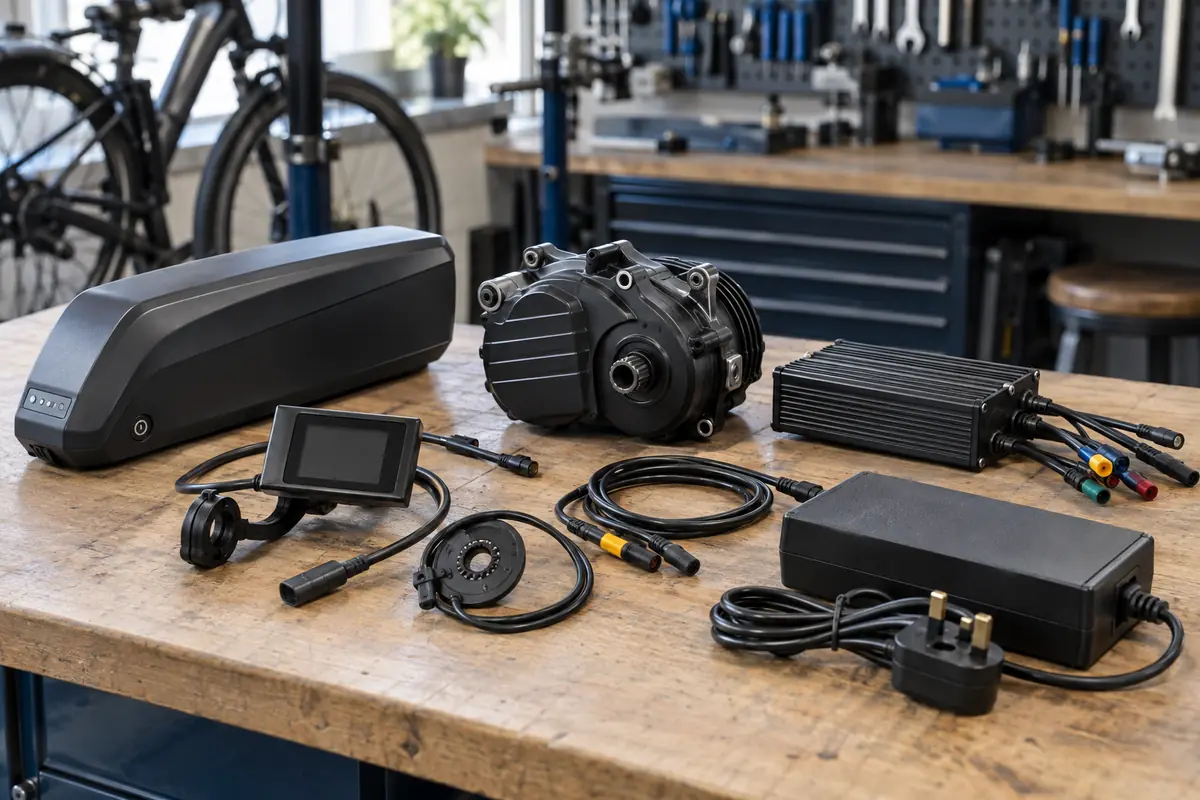
An e-bike adds a linked electrical system to otherwise familiar bicycle components. A fault that appears at the display can originate in a sensor, cable, controller, battery connection or firmware, so diagnosis should precede parts ordering.
Voltage, capacity, mounting rail, connector, communication protocol, battery management system, firmware and charger approval can all matter.
Connector fit is not proof of compatibility. Output voltage, current, polarity, charging communication and manufacturer approval must match.
A motor replacement can depend on axle or frame mounting, wheel size, winding, controller, sensors, software and legal system configuration.
The controller regulates power between the battery and motor. Ratings, connectors and programming must suit the complete approved configuration.
Displays can be tied to a system generation and communication protocol. A physically similar screen may not pair, configure or diagnose the bike.
Speed, cadence, torque and brake sensors, wiring harnesses and junctions require the correct connector, position, calibration and software support.
Tyres, brake pads, chains, cassettes, wheels and bearings remain conventional bicycle parts, although an e-bike’s mass, torque, speed category and maker’s approvals can change the specification required. Start with the bike parts hub for those items and return here when the electrical system is involved.
Record the bicycle make, exact model, model year and frame serial number, then identify the motor-system maker, drive-unit model, battery model, charger model, display and any current error code. Photograph labels and every connector before disconnecting anything.
Compatibility can be limited by system generation as well as brand. Components may exchange data, verify a battery, require dealer configuration or depend on firmware combinations. A replacement that fits mechanically may still fail to operate, produce errors, charge incorrectly or create a safety risk.
Use the bicycle maker’s parts catalogue or an authorised system compatibility chart for the exact models involved. Do not rely on marketplace titles such as “universal”, “Bosch-style”, “36V compatible” or “same connector” without documented approval.
Use the charger supplied with the e-bike or a replacement authorised by the manufacturer for that battery and system. A connector adapter cannot make an electrically unsuitable charger safe. Do not charge a battery that is swollen, cracked, leaking, unusually hot, has suffered a severe impact or shows other damage.
A battery rebuild, cell replacement or battery-management-system modification is not equivalent to replacing ordinary bicycle cells or bearings. It can change the pack’s protection, insulation and thermal behaviour. Use the manufacturer or a competent service route that accepts responsibility for the complete pack and supplies the required documentation.
Charge in accordance with the maker’s instructions, away from escape routes and combustible materials, and while you are present and awake. Do not cover the battery or charger, and unplug it when charging is complete as instructed. The UK Government’s battery-safety advice for e-cycle users explains the official precautions.
Unusual heat, swelling, hissing, cracking, leaking, a strong odour or smoke can indicate a serious failure. Move away, warn others and call the emergency services where there is immediate danger. Do not attempt to open or cool a failing pack yourself.
| Step | What to record | Why it matters |
|---|---|---|
| 1. Identify the bicycle | Make, exact model, model year, frame serial and original specification | Manufacturers may change electrical systems within a model family |
| 2. Identify the system | Drive unit, battery, charger, display, controller and sensor model codes | The visible fault may not identify the failed component |
| 3. Retrieve diagnostics | Error code, symptoms, conditions and work already attempted | Replacing parts by trial can be expensive and may hide a wiring or firmware fault |
| 4. Confirm compatibility | Written manufacturer chart, parts catalogue or authorised dealer confirmation | Physical fit alone does not prove electrical or software compatibility |
| 5. Confirm support | Warranty, returns, installation, pairing, firmware and future replacement route | A cheaper unsupported component can leave the bicycle unusable |
For conversion systems, use the dedicated electric bike conversion guide and conversion-kit comparison. A conversion component should be checked against the donor bicycle and the rest of the chosen kit, not treated as a generic upgrade.
Ask for the current replacement price and expected availability of the battery, charger, display, motor and controller. Establish who can perform diagnostics locally and whether essential work requires an account, proprietary tool or dealer network.
Check whether the battery can be removed for charging and replacement, whether the motor uses serviceable bearings or is replaced as a unit, and how long the manufacturer commits to software and parts support. A low purchase price can be false economy if one unavailable display or battery writes off an otherwise sound bicycle.
For complete-bike selection, return to the electric bike guide and reviews. For tyres and other conventional wear items, use the bike tyres guide and the wider bike parts hub.