Best electric bike conversion kits for UK riders
Compare nine conversion options from Swytch, Cytronex, Woosh and Pendix, with motor layouts, battery choices, complete-kit costs and the compatibility checks that decide what will work on your bike.
Start here
- For a removable compact pack, investigate Swytch MAX+; for a discreet bottle system, compare Cytronex.
- For conventional front or rear hub conversions, compare the complete Woosh configurations after a fit assessment.
- For crank assistance, compare a correctly configured BBS01B or TSDZ2B with the professionally assessed Pendix route.
- Do not buy until the supplier confirms the exact bicycle, complete contents, UK configuration, battery and support arrangements.
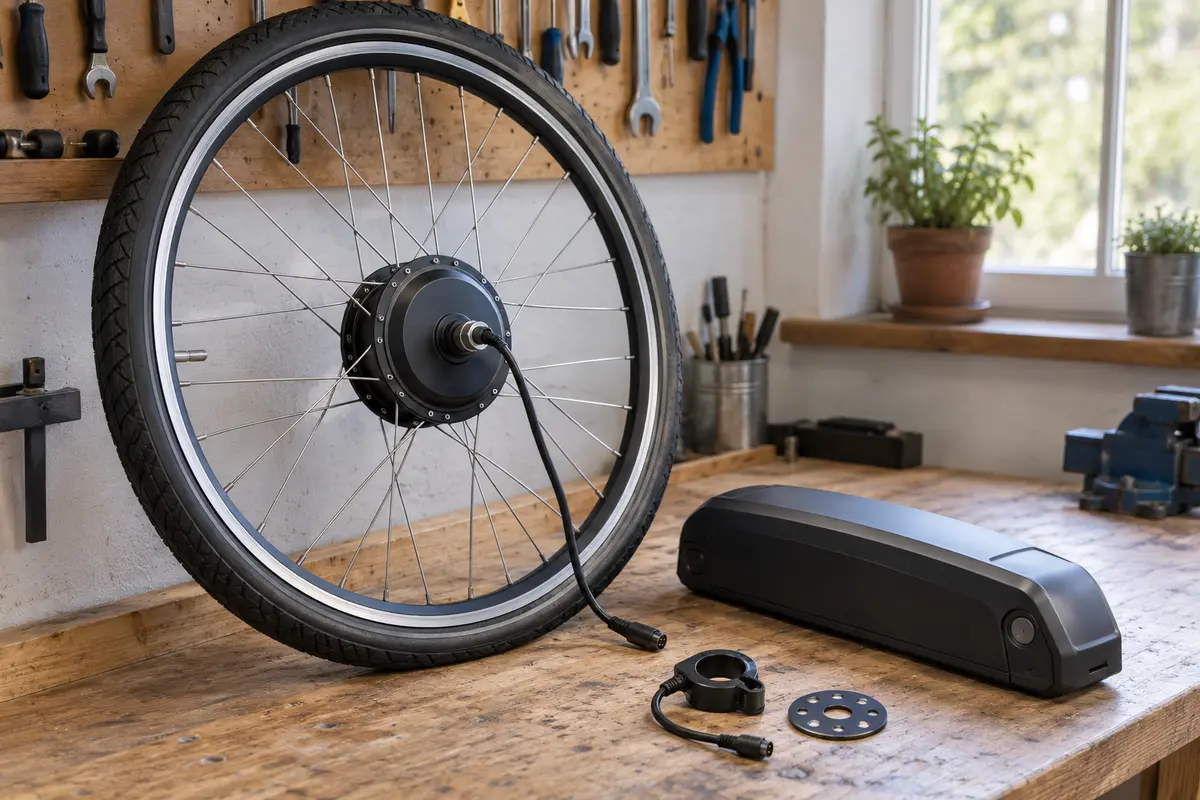
Best conversion kits: compare the options at a glance
The shortlist groups products by the job they can suit. It uses published specifications and supplier information, not claimed hands-on testing of every system. Listed prices were checked on 12 September 2026 and are starting configurations, not promises of stock or an installed total.
| System | Motor arrangement | Battery choice | Price context |
|---|---|---|---|
| Swytch MAX+ / MAX++ | Front hub; rear options require a separate compatibility check | MAX+: 275.4Wh actual; MAX++: 361.8Wh actual | Configure complete kit and delivery batch |
| Cytronex front-hub kit | 250W front hub | 198Wh bottle, containing two 99Wh packs | Configure wheel, charger and fitting |
| Cytronex rear through-axle kit | 250W rear hub; 142 × 12mm | 198Wh bottle system | Configure cassette, wheel and charger |
| Cytronex Brompton kit | Brompton-specific front hub | 198Wh bottle system | Quote against exact Brompton model |
| Woosh XF07 front-hub kit | 36V front hub; pedal sensor | Listed 10Ah bag or larger downtube/rack options | Listed from £449 with 10Ah bag battery |
| Woosh XF08C / DWG2NC rear-hub kit | 36V rear hub; cassette fitting | Listed 13Ah or 20Ah configurations | Listed from £529 with 13Ah downtube battery |
| Woosh Bafang BBS01B 250W kit | Crank drive; cadence sensing | 36V complete-kit options; 15Ah bag option listed | Listed from £640 with 15Ah bag battery and charger |
| Woosh Tongsheng TSDZ2B 250W configuration | Crank drive; torque sensor | 48V complete-kit options | Listed from £449 with 10Ah bag battery and charger |
| Pendix eDrive500 | Gearless mid-drive; 250W, 65Nm | 497Wh, 48V | Obtain UK supply and fitting quote |
A higher price may include more battery energy, a better wheel build or a more comprehensive support arrangement. A lower number may simply describe fewer parts. Use the complete conversion guide if you need the motor types, fitting process and ownership responsibilities explained first.
Choose a compatible system before choosing a winner
First eliminate kits that do not fit your bicycle or that the supplier will not approve for it. Next decide where the battery can be mounted safely, how much energy the route requires and whether the complete bike will remain manageable to lift and store. Then compare control feel, service support and price.
The selections deliberately include different wheel and motor arrangements. The three Cytronex entries address different donor-bike requirements; Swytch MAX+ and MAX++ are grouped because they are battery variants. Woosh’s paired rear motor names are also grouped rather than counted as separate winners without knowing the final configuration.
Manufacturer range claims are not a level playing field. A small battery tested with a light rider and low assistance cannot be compared directly with a larger battery on a loaded hilly route. Watt-hours, a sensible reserve and a demonstration on similar terrain are better starting points.
The conversion kits in detail
Swytch MAX+ / MAX++
A removable battery is useful if the bicycle lives in a shared store but you charge elsewhere. Swytch advertises these packs as 280Wh and 370Wh, and publishes the more precise capacities alongside them. The two sizes share the same overall approach; they are battery choices within a system, not two entirely different motor designs.
Worth considering for: Short-to-medium urban journeys where battery removal and a relatively compact system matter. The larger pack provides more stored energy without changing the basic buying decision.
Before you order: Specify the UK/EU assistance configuration, exact wheel and axle, brake format and battery mount. Swytch’s ordering guidance describes pre-order batches: inspect the delivery date before paying. The pack’s USB-C port is described as an output for mobile devices, and its integrated visibility light should not be assumed to replace an appropriate road light.
Read the Swytch MAX+ / MAX++ specification and supply optionsCytronex front-hub kit
Cytronex puts the battery and electronics in a removable bottle-shaped unit and uses a gear-tooth sensor. Its standard front-hub arrangement is an option for a compatible quick-release bicycle when a modest battery and a relatively discreet installation suit the journey.
Worth considering for: A rider who likes their current bicycle and values direct system support and an unobtrusive battery position. Start here if your commute is short enough that battery capacity is not the overriding requirement.
Before you order: Use the manufacturer’s fit assessment for the fork, brakes and bottle mounting points. A 198Wh pack stores materially less energy than a 500Wh-class pack; a high claimed mileage does not cancel that difference. Request a realistic range discussion for your weight, hills and preferred assistance.
Read the Cytronex front-hub kit specification and supply optionsCytronex rear through-axle kit
The rear Cytronex system addresses a fit problem that rules out many conventional hub kits: a 142 × 12mm rear through-axle. It is a separate compatibility option, not evidence that any through-axle bicycle can accept an electric wheel.
Worth considering for: Owners of an otherwise suitable disc-brake bicycle whose axle standard matches this system. Keeping the front wheel conventional can also simplify the front end of the installation.
Before you order: Have Cytronex confirm frame clearance, freehub and cassette configuration, rotor interface, wheel size and the required axle arrangement. Do not treat a frame’s nominal axle dimensions as permission to electrify it. Ask who will build, tension and service the motor wheel.
Read the Cytronex rear through-axle kit specification and supply optionsCytronex Brompton kit
A Brompton conversion needs more than a small wheel. Fork spacing, gearing, cable movement, luggage and the folded package must all work together. Cytronex offers a dedicated Brompton route, which makes a manufacturer-led assessment more useful than choosing a generic 16in motor wheel.
Worth considering for: A rider who already owns a suitable Brompton and wants to compare keeping it against buying a complete electric folder.
Before you order: Confirm the exact model and generation with Cytronex, including any carbon or titanium components. Check the effect on the original bicycle warranty and practise the fold with the battery and luggage arrangements fitted. Compare the complete cost and lifting weight with the purpose-built electric alternative.
Read the Cytronex Brompton kit specification and supply optionsWoosh XF07 front-hub kit
The XF07 is a practical candidate when the priority is a complete conversion at a relatively modest listed price. Battery position is part of the configuration: a bag, downtube or rack arrangement can change whether the kit is usable on a particular frame.
Worth considering for: A sound, conventional commuter that passes the supplier’s assessment and has an approved fork and battery mounting arrangement.
Before you order: Woosh excludes carbon forks and through-axle frames from this hub-kit range. Check wheel size, brakes and all required sensors. Some packages include a throttle; establish the compliant supplied configuration before ordering. A component list is not confirmation that the finished bicycle meets EAPC rules.
Read the Woosh XF07 front-hub kit specification and supply optionsWoosh XF08C / DWG2NC rear-hub kit
This rear-hub family is worth comparing when you want to retain a conventional front wheel and your bicycle uses a compatible cassette. The configuration list includes two motor names, so have the supplier identify which one will be built into your chosen wheel.
Worth considering for: Commuters with a suitable rear dropout, room for a securely mounted battery and a preference for hub assistance without replacing the crank assembly.
Before you order: Match cassette type, speed count, dropout, rotor and wheel dimensions. Check hydraulic-brake sensor requirements and learn the approved puncture-removal procedure. Do not force a motor into a frame or infer fit from a broad published dropout range.
Read the Woosh XF08C / DWG2NC rear-hub kit specification and supply optionsWoosh Bafang BBS01B 250W kit
A mid-drive uses the bicycle’s gearing, making this a relevant option to investigate for a hilly route. The BBS01B is a specific 250W configuration; similarly named higher-powered Bafang systems should not be substituted on the assumption that a display restriction makes them equivalent.
Worth considering for: A suitable bicycle with a compatible bottom bracket and useful low gearing, where a competent installer accepts the work and the rider understands shifting under motor load.
Before you order: Woosh specifies common 68–73mm bottom-bracket shells and requires installation by a competent mechanic. Chainline, clearance, front-derailleur removal, brake sensors and mounting space can add work. Ask whether the cadence-sensing response suits you and compare the final quote with a supported complete e-bike.
Read the Woosh Bafang BBS01B 250W kit specification and supply optionsWoosh Tongsheng TSDZ2B 250W configuration
Torque sensing makes assistance respond to pedal effort, which can appeal if you want a more proportional relationship between your legs and the motor. The TSDZ2B is worth investigating as a system and installation package, rather than comparing a bare motor price with a complete kit.
Worth considering for: A rider who specifically wants torque-sensing crank assistance and can obtain written confirmation of compatibility and the completed road configuration.
Before you order: The supplier page mixes model variants and describes full-throttle options. Resolve the motor label, controller, assistance cut-off, throttle approval and exact battery before purchase. Do not treat every TSDZ listing as the same product. Woosh does not recommend this model for cargo bikes; we are not giving a blanket road-legality endorsement to the family.
Read the Woosh Tongsheng TSDZ2B 250W configuration specification and supply optionsPendix eDrive500
Pendix takes a different approach to the crank conversion, with a gearless motor and frame-mounted removable battery. The eDrive500 is a candidate when retaining a particular bicycle and obtaining a professionally assessed installation matter more than minimising the initial purchase price.
Worth considering for: A compatible city or trekking bicycle that the installer considers worth retaining. Pendix describes support for suitable chain- and belt-drive arrangements, but that must be checked on the actual bike.
Before you order: The published system weight is 7.3kg and the mounting requirements include a BSA bottom bracket plus sufficient motor and battery space. That weight increase matters for stairs and racks. Get a UK configuration, fitted quote, parts-support arrangement and realistic range assessment; the international euro price is not a UK installed price.
Read the Pendix eDrive500 specification and supply optionsCompare the complete fitted cost, not the headline kit price
Send the same specification to each supplier: donor make, model and year; wheel and tyre size; axle dimensions; brake type; drivetrain; rider and luggage weight; and the route you intend to ride. Ask for an itemised quotation and keep a copy of the agreed configuration.
| Cost | Why it changes the comparison |
|---|---|
| Motor and wheel or crank assembly | Wheel build, rim, spokes, cassette compatibility and chainring changes can differ |
| Battery and approved charger | Capacity and charger inclusion are major differences between listings |
| Mounts, sensors and controls | A hydraulic-brake sensor, battery bracket or display may be an extra |
| Mechanical preparation | Worn pads, tyres, chain or bearings are separate from the motor installation |
| Labour and handover | Agree fit assessment, electrical setup, safety checks and follow-up work |
| Delivery and aftercare | Confirm delivery eligibility, returns shipping, spare parts and warranty handling |
If the total approaches a suitable complete e-bike, compare both routes. A conversion retains a familiar fit; a complete bicycle can offer one dealer responsible for the whole machine. Browse Tenways urban bikes, Brompton electric folders and the UTO range as relevant alternatives, not interchangeable substitutes for every kit.
The compatibility checklist to complete before ordering
- Condition: have the frame, fork, wheels, brakes and drivetrain assessed. Do not electrify a damaged donor to avoid repairing it.
- Wheel and axle: record ETRTO wheel size, hub spacing, axle diameter and fixing method. Get written approval for carbon, suspension or unusual frames.
- Transmission: distinguish cassette from freewheel, identify the freehub and count the sprockets. For a mid-drive, identify the bottom-bracket standard and shell dimensions.
- Battery: use the mounting template, allow removal space and check steering, suspension travel and the fold. Frame modification needs explicit approval.
- Brakes and controls: check lever and sensor compatibility, cable routes, display space and any required torque-reaction hardware.
- Finished bicycle: calculate the loaded weight, check rack limits, confirm a secure parking and charging arrangement, and arrange a handover.
Do not file dropouts, drill frames, force axles or alter battery connections to make an incompatible purchase fit. A supplier’s installation manual applies to its exact product; this comparison is not a substitute for that manual or a competent mechanic.
A UK road configuration needs more than a 250W title
Confirm the finished bike against current EAPC requirements, including usable pedals, maximum continuous motor rating, assistance cut-off and required markings. Throttle operation can introduce approval requirements. A switchable high-speed mode or a software limit on a differently rated motor does not establish compliance.
Ask the supplier to identify the exact road configuration and its documentation before paying. This is especially important where one listing mixes motor variants or includes a full throttle. Our conversion guide explains the legal checks in more detail.
Make the final choice around your actual journey
For a short commute with stairs, concentrate on complete lifting weight and battery removal. For longer rides, prioritise usable capacity, a charging plan and suitable gearing. For a valued folding bicycle, insist on model-specific compatibility and test the complete fold. For a demanding hill, ask for an assessment using the actual gradient and loaded weight.
Finally, ask what happens if the system stops working next winter. A clear route to a replacement battery, a diagnostic service and someone willing to work on the motor wheel can matter more than a small initial saving. Keep the serial numbers, manuals, receipt and agreed specification together.
Frequently asked questions
Which electric bike conversion kit is best overall?
There is no universal winner because axle standards, frame condition, battery space, terrain and support differ. Start with compatible systems, then compare the complete fitted price and the way assistance feels. A highly rated kit that does not fit your bicycle is not a good purchase.
What is the cheapest complete option in this comparison?
The supplier pages checked on 12 September 2026 listed the Woosh XF07 with a 10Ah bag battery and a TSDZ2B configuration with a 10Ah bag battery from £449. These are listing snapshots, not guaranteed installed prices. Configuration, compatibility, delivery eligibility and fitting must be confirmed before purchase.
Does a conversion kit include a battery?
Some do and some do not. A motor-only listing can exclude the battery, charger, wheel build, display or sensors. The complete cost comparison must use a matched system with everything required for the specific bicycle.
Is a hub motor or mid-drive better for hills?
A mid-drive can use the bicycle’s low gears, but fit, gearing, control settings, rider effort and heat management all affect a real climb. Do not compare hub and crank torque numbers as if they were measured at the same point. Seek a demonstration or supplier assessment for the actual route.
Can a kit fit a through-axle bicycle?
Some specifically designed systems can. The Cytronex rear option described here targets 142 × 12mm, while Swytch also lists particular rear through-axle options. Neither means that a generic front hub or every modern mountain bike is compatible.
Can I use any battery with a Bafang or Tongsheng motor?
No. Buy a battery, controller and charger combination approved by the kit supplier. Voltage, current capability, electronics, connectors and physical fit all matter. Do not modify a pack or join incompatible chargers and batteries.
Sources and product information
Read the original specifications, instructions and official guidance. Availability, bundles and product details can change.