The short version
- Best for: frequent urban and leisure riders who prefer a conventional high-step frame and want more comfort and gearing than District+ 2 without moving to a 75Nm motor
- How the electrical assistance is delivered: Bosch Active Line Plus, 50 Nm.
- Battery and charging capacity: Bosch 400 Wh
- Main trade-off: Same 50Nm motor as District+ 2
Where the District+ 3 400Wh fits
The clearest match is frequent urban and leisure riders who prefer a conventional high-step frame and want more comfort and gearing than District+ 2 without moving to a 75Nm motor. Compare the complete specification and available independent coverage before choosing a size or variant.
Motor, controls and UK legality
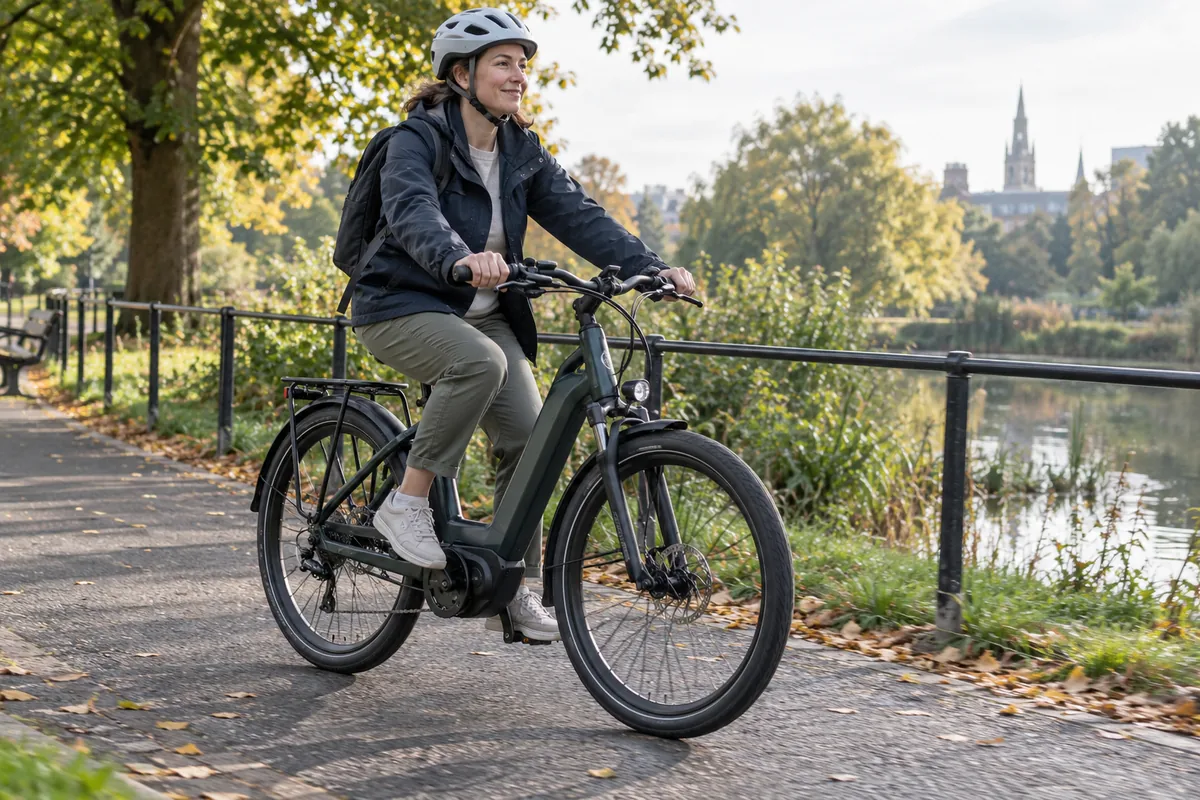
The motor is Bosch Active Line Plus, 50 Nm.. The controls are Bosch Purion 200.
The listed 50Nm Bosch Active Line Plus is a proven city and light-touring drive with quiet, natural assistance. Independent tests find it strong enough for most urban riding while remaining less forceful and intrusive than sportier mid-drives.
District+ 3 does not increase torque over District+ 2. Its extra eighth gear helps the rider keep a comfortable cadence, but buyers needing substantially more hill or load capability should look to the 75Nm District+ 4 rather than paying for chassis refinements alone.
For use as an electrically assisted pedal cycle in Great Britain, the maximum continuous rated motor power must not exceed 250W, assistance must cut out by 15.5mph and the pedals must be able to propel the bike. Check the label and delivered configuration rather than relying on a category name.
| Listed price | £2,049 |
|---|---|
| Motor | Bosch Active Line Plus, 50 Nm. |
| Battery | Bosch 400 Wh |
| Range information | No numerical range is stated in the accessible listing; route, rider, weather and assistance level materially affect distance |
| Controller | Bosch Purion 200 |
| Frame | High-performance hydroformed alloy, Removable Integrated Battery, internal cable routing, Motor Armour, post-mount disc |
| Transmission | Shimano Nexus Revo, 8-speed |
| Brakes | Shimano MT200 hydraulic disc |
| Tyres | Bontrager E6 Hard-Case Lite, reflective strip, 27.5x2.40 |
| Fork and suspension | SR Suntour NVX30, coil spring, preload adjuster, 100 mm QR, 60 mm travel |
| Complete-bike weight | Not stated in the accessible the seller listing |
| Listed sizes | L |
| Listed colours | Lithium Grey 25 |
Battery, charging and realistic range
The listed battery is Bosch 400 Wh. No numerical range is stated in the accessible listing; route, rider, weather and assistance level materially affect distance
The 400Wh removable integrated battery is moderate for a well-equipped city e-bike and should be judged against the actual return route. High assistance, cold weather, soft tyres and luggage can all reduce achievable distance.
Removal is a meaningful practical advantage for charging and storage, but it is not evidence of long touring range. Trek markets other capacities in the wider District family; this review applies only to the the seller 400Wh product.
Use only the approved compatible charger, charge away from escape routes and stop using a battery that is damaged, swollen, leaking or unusually hot. Ask for the replacement-pack price and warranty conditions before the original battery becomes a problem.
Frame, fit and ride character
The frame specification is High-performance hydroformed alloy, Removable Integrated Battery, internal cable routing, Motor Armour, post-mount disc. Fork and suspension details are SR Suntour NVX30, coil spring, preload adjuster, 100 mm QR, 60 mm travel. The tyres are Bontrager E6 Hard-Case Lite, reflective strip, 27.5x2.40.
The combination of a 60mm coil fork, suspension seatpost and 27.5x2.4 tyres provides appreciably more isolation than the narrower-tyred District+ 2. A high-step frame should feel conventional and stable, while the eight-speed hub gives a finer choice of cadence.
Those comfort parts add weight and can soften feedback, so this is a relaxed transport bike rather than a brisk fitness hybrid. Tyre pressure should be set for load and surface rather than automatically inflated to the maximum sidewall figure.
Brakes, transmission and everyday equipment
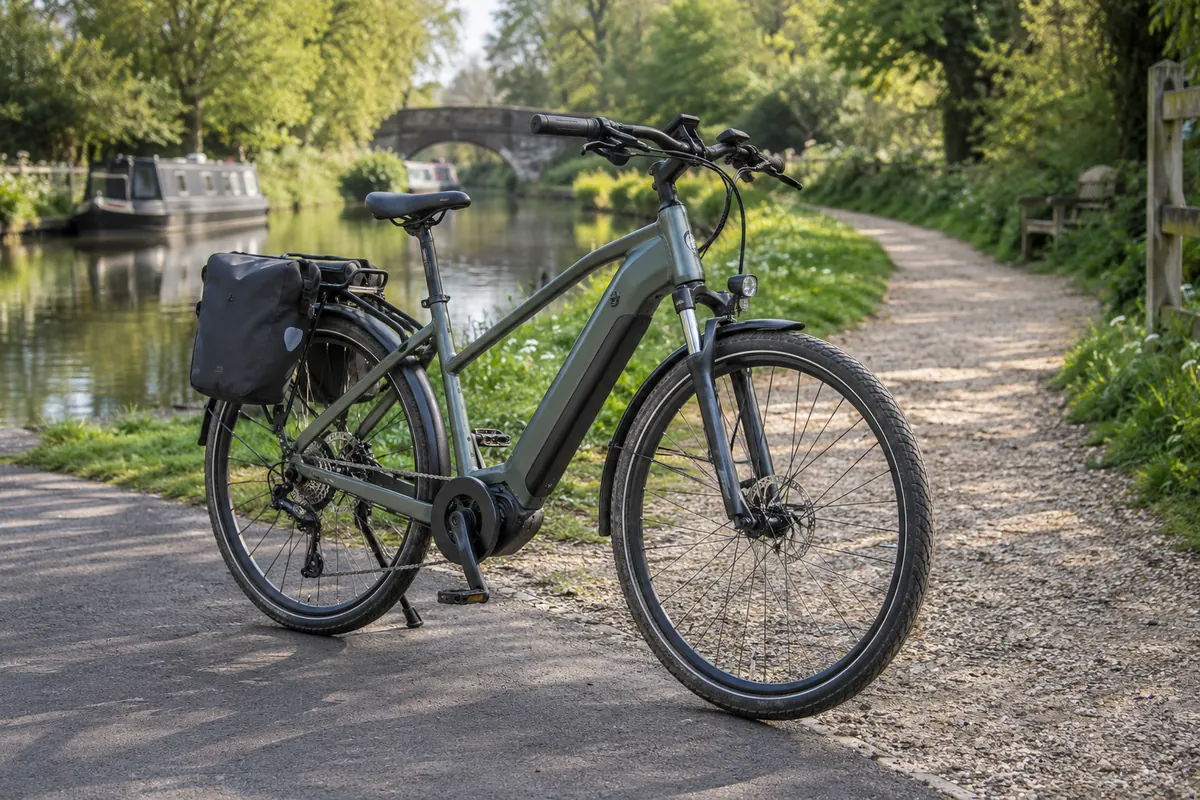
The bike uses Shimano MT200 hydraulic disc. Transmission is Shimano Nexus Revo, 8-speed. The equipment information is Lights, Kickstand, Cargo Rack and Mudguards; Alloy, suspension, 31.6 mm, 300 mm length.
Lights, rack, full mudguards, kickstand and reflective tyres make the bike suitable for daily travel. Nexus gearing is enclosed and can shift while stationary, while the chain uses common service parts and is straightforward for most workshops.
A chain needs cleaning and lubrication that the District+ 3 Belt Lowstep avoids. The high-step frame also demands more clearance when mounting with loaded panniers, so the otherwise similar Lowstep should be tried before choosing on appearance alone.
What the published evidence tells us
The recorded price for this build is £2,049. Prices can differ by colour or size, and stock can change; a discount against a reference price does not by itself establish value.
The seller and Trek provide an exact product trail for the District+ 3, while Road.cc and Gran Fondo independently support the 50Nm Active Line Plus motor's quiet, natural behaviour. No credible independent review of this precise complete bike was found.
The published components and geometry distinguish this build from other District variants. Generic owner comments should not be transferred between materially different motors, batteries or drivetrains.
Advantages and disadvantages
The useful comparison is whether the complete build suits the regular route, storage and service plan. A premium motor cannot compensate for poor fit, while a modest component can be entirely sensible on the right type of bike.
- Advantage: Eight-speed internal hub offers more cadence choice
- Advantage: Wide tyres, suspension fork and suspension post improve comfort
- Advantage: Removable integrated battery simplifies charging
- Advantage: Complete all-weather city equipment
- Disadvantage: Same 50Nm motor as District+ 2
- Disadvantage: 400Wh remains moderate for long high-assistance rides
- Disadvantage: Comfort hardware and city kit add weight
- Disadvantage: Chain requires more routine care than the belt version
Buying checks and RideIn verdict
Confirm the exact product code, frame size, colour, battery capacity, assistance configuration and included equipment before paying. Ask who will handle electrical diagnosis, warranty labour and replacement components, then test the brakes, controls and fit before committing to regular use.
A polished high-step city and leisure bike whose extra money buys comfort and gearing rather than power; worthwhile for longer everyday rides, less so if District+ 2 already meets the route.
Technical and safety references
RideIn compared the captured retailer listing with the cited manufacturer and independent material. RideIn has not ridden this individual bike, and independent coverage of another year or build is used only as context, not as proof of this model's performance. The retailer source remains visible because it is the evidence for the recorded price, size and build snapshot.
- Trek District+ 3 400Wh at the seller↗Current the seller UK listing, price, sizes, colours and sale specification.
- Trek official electric-bike range↗Manufacturer range and system context; the exact the seller build remains the review reference.
- Trek official product information↗Official product specifications and system details.
- Trek official product information↗Official product specifications and system details.
- road.cc review↗Independent editorial coverage used for ride context; the exact the seller components may differ.
- GRAN FONDO review↗Independent editorial coverage used for ride context; the exact the seller components may differ.
- GOV.UK electric-bike rules↗
- UK Government e-cycle battery safety↗
- UK product-safety alerts and recalls↗