eAnt folding bike review
eAnt folding-bike review comparing standard and Pro battery configurations, the 14-inch format and unresolved production and range claims.
Product evidence checked 7 October 2026
Our assessment
eAnt is an interesting compact folding proposal, but the public evidence does not yet justify treating the configurator as a delivered, independently tested production bike. Confirm final dimensions, weight, fulfilment terms and the exact legal motor configuration before paying.
Published specification
| Standard motor configuration | 250W; 15.5mph advertised assistance limit |
|---|---|
| Standard battery | 36V 15Ah (540Wh nominal) |
| Pro battery configuration | 15Ah seat pack plus 15Ah rack pack (1,080Wh nominal at 36V) |
| Configurator claimed range | Standard 30–45km; Pro 60–90km |
| Optional rack packs | 20Ah or 35Ah described in the configurator |
| Advertised wheel size | 14 inches |
| Advertised folded dimensions | 76 × 52 × 73cm |
| Advertised weight | 20–23kg; final configuration and definition need confirmation |
| Upgrade claims | 350W/22mph or 500W/35mph; outside ordinary British EAPC limits |
Specifications can change between markets and production batches. Match these entries to the exact supplied version.
What stands out
- Compact advertised folding dimensions and 14-inch wheel format.
- Standard and Pro battery configurations are distinguishable in the configurator.
Limitations and unknowns
- Production fulfilment and final delivered specifications remain unconfirmed.
- Public range claims use inconsistent units and configuration assumptions.
- High-power upgrade options need a different legal assessment.
The standard and Pro are different battery configurations
The public buy.eant.club configurator describes a 36V 15Ah seat battery for the standard bike. That works out to 540Wh nominal energy. The Pro adds a 15Ah rack pack, taking the stated total to 1,080Wh; those are calculations from the listed voltage and capacity rather than usable-energy measurements.
Optional 20Ah and 35Ah rack packs are also described. Establish whether a quotation includes one battery or two, how the system selects or combines them, and the final complete-bike weight. A larger pack can extend stored energy while making a folded bicycle harder to carry.
A compact folder still needs a carrying demonstration
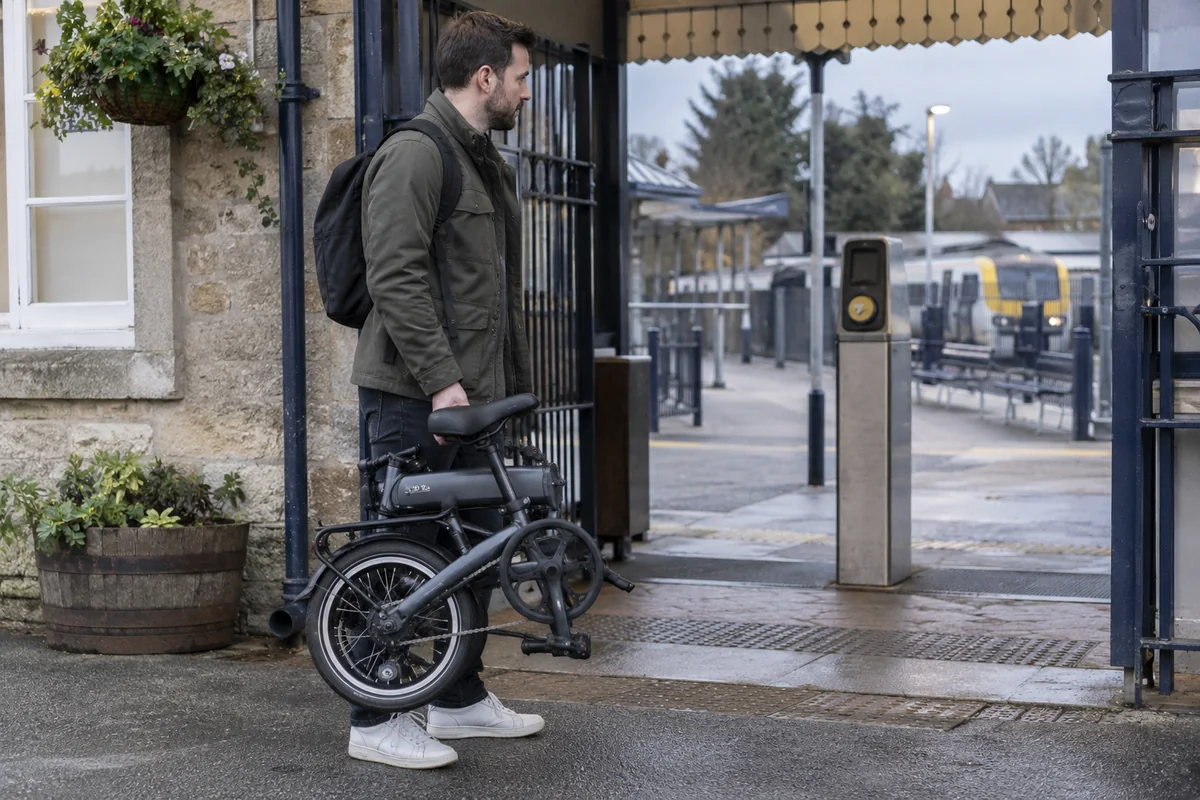
The eant.club marketing page advertises 14-inch tyres, front and rear suspension and a 76 × 52 × 73cm fold. That compact wheel format makes a trial especially useful for steering, rough road surfaces and saddle adjustment; catalogue dimensions cannot demonstrate stability or comfort.
The quoted 20–23kg weight spans configurations without a sufficiently clear ready-to-ride definition. Confirm which battery, rack and accessories are included, whether the folded bike locks together, and how it can be lifted without loading electrical cables or a vulnerable hinge.
Range claims conflict across public pages
The configurator gives 30–45km for standard and 60–90km for Pro. Elsewhere the brand uses much broader range claims with inconsistent miles and kilometres. Those figures should not be merged into a single confident maximum; ask for the exact test conditions for the configuration ordered.
The smaller configurator figures are recorded here as supplier claims, not measured results. Rider mass, hills, assistance level, tyre pressure and cold weather can all change the outcome. A test on a representative route is needed before relying on the bike for a long daily journey.
Launch status, support and road legality
EKOO Group’s public homepage still describes forthcoming launches. A working order or configuration page alone does not establish delivered stock, production quality or warranty capacity. Obtain dispatch timing, cancellation and refund terms, the legal seller’s identity and a model-specific parts commitment in writing.
The 250W/15.5mph setting is the relevant starting point for an ordinary British EAPC assessment, but pedal operation, throttle behaviour and required markings still need confirmation. The advertised 350W and 500W upgrades cannot simply inherit ordinary EAPC treatment. There is no RideIn road test or verified owner fleet behind this review.
Sources and review method
- eAnt public product overview
- eAnt public configurator and catalogue
- EKOO Group launch information
- GOV.UK: electric-bike rules
Supplier statements are attributed to the product page. Practical assessments are RideIn’s interpretation of that evidence. There is no independent range, braking, durability or ride-quality test behind this article.