The short version
- Buildings, contents, bicycle and liability cover answer different losses
- Conversion batteries feature heavily in reported fires
- Storage must protect escape routes as well as the bike
- Ask insurers specific questions and keep their answers in writing
Why poorly built batteries change the insurance risk
Lithium-ion cells store enough energy for a failure to develop rapidly. Poor cell quality, weak connections, inadequate physical protection, an ineffective battery-management system or an incompatible charger can allow one cell to overheat and trigger neighbouring cells. The resulting thermal runaway can release flammable and toxic gases, fire and explosive pressure.
OPSS received reports of 170 e-bike fires in 2024. Seventy-seven involved post-market conversions, 59 were of unknown build and 34 were confirmed manufactured e-bikes. Reporting is voluntary and heavily influenced by London submissions, so those figures describe the notified incidents rather than the national failure rate. They nevertheless show why construction, traceability and compatibility matter to an insurer.
- Untraceable cells, batteries or importers
- No reliable evidence that the battery and charger were assessed together
- Used packs with an unknown crash, repair or charging history
- Home-built wiring, connectors or battery enclosures
- Replacement parts outside the original maker's specification
One fire can involve several different policies
Buildings insurance protects the structure and permanent fixtures; contents insurance protects possessions; specialist cycle insurance may protect the e-bike; and liability cover may answer an allegation that the owner damaged another person's property or caused injury. A landlord's policy, a tenant's contents policy and the block's buildings insurance protect different interests.
Do not assume that insuring the bicycle insures the building against a battery fire, or that a buildings policy replaces the failed bike. A policy may cover resulting fire and smoke damage while excluding the defective battery, electrical breakdown, faulty workmanship or the cost of correcting the original defect.
- Structure, fitted kitchen and permanent fixtures
- Furniture, clothing and other household contents
- The bicycle, battery, charger and accessories
- Alternative accommodation or loss of rent
- Injury or damage suffered by neighbours and visitors
- Business interruption where the premises cannot trade
When an insurer may question or restrict a claim
The starting point is the issued policy, schedule and the cause of the loss. The Financial Ombudsman Service looks at definitions, exclusions, the evidence of causation and whether an insurer has applied a term fairly. Ordinary carelessness does not automatically erase all cover, but a deliberate act, a clear exclusion or a serious failure to comply with a relevant condition can change the result.
For consumer insurance, answer the insurer's clear questions accurately and update information when the contract requires it. A home owner should not guess whether indoor charging, a conversion kit or several delivery bikes counts as a material change; describe the real arrangement and request a written answer. Commercial policyholders and businesses should discuss the exposure with their broker or insurer before storing, charging, repairing or importing batteries.
- Was the battery subject to a safety alert or recall?
- Was it visibly swollen, leaking, damaged or overheating?
- Was the charger supplied or authorised for that exact battery?
- Had the bike been converted, repaired or de-restricted?
- Was charging unattended, overnight or on an escape route?
- Were the declared use, storage location and number of batteries accurate?
Storage should limit the severity of a fire
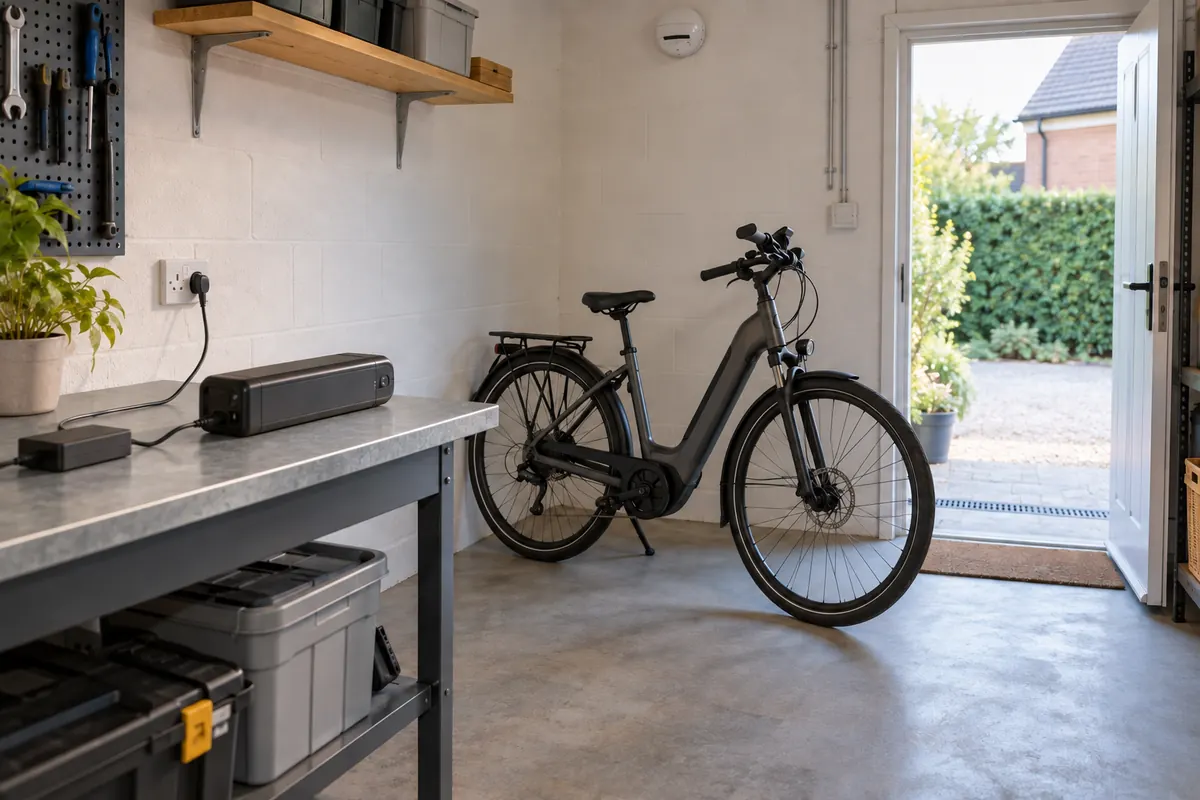
Government guidance recommends storing and charging an e-bike or battery in a garage or shed separate from the home where possible. The space still needs to follow the maker's temperature and moisture limits, keep batteries away from combustible materials and provide suitable detection. A detached space is not safe merely because it is outside.
Never store or charge an e-bike in a corridor, stairwell or another place that could prevent escape. Use the supplied or manufacturer-authorised charger, allow a hot battery to cool, charge only while awake and present, and unplug when charging is complete. Do not charge a dropped, crushed, leaking, swollen or unusually hot battery.
- A hard, stable charging surface with heat able to disperse
- No paper, fuel, textiles or other easy fuel beside the battery
- A clear route out of the property
- Working detection appropriate to the room
- No overloaded socket or tightly coiled extension lead
- Battery and charger serial numbers kept away from the storage area
Flats, rented homes and communal stores
A tenant's contents policy will not normally replace the landlord's building. Equally, a landlord's policy does not automatically protect the tenant's possessions or personal liability. The building insurer or freeholder may also impose rules for communal areas, cycle rooms and charging.
Landlords, employers and managing agents responsible for fire safety should include e-bikes in the building's fire-risk assessment. London Fire Brigade highlights storage location, communal charging, blocked escape routes and communication with occupants. A proportionate plan distinguishes compliant, well-maintained e-bikes from unknown or damaged equipment while controlling the actual charging risk.
- Check the tenancy, lease and building rules
- Ask where removable batteries may be charged
- Keep all doors, corridors and stairs unobstructed
- Provide residents with a reporting route for damaged batteries
- Confirm which party insures the building, contents and liability
Businesses face an accumulation problem
A shop, delivery hub, repairer, office or storage operator can have many batteries exposed to one fire. Charging several packs together, accepting damaged units or holding uncollected conversions can turn a small individual risk into a severe property, interruption and public-liability loss.
Tell the commercial insurer what the business actually does. General shop or property cover should not be assumed to include battery repairs, e-bike conversions, imported products or responsibility for products placed on the UK market. The fire-risk assessment and insurer requirements should address maximum quantities, separation, detection, damaged-battery quarantine, staff training and emergency procedures.
- Maximum number and total capacity of batteries on site
- New, used, damaged and waste batteries separated by status
- Supervised charging area and electrical installation
- No charging in customer or staff escape routes
- Product, public and employers' liability checked separately
- Business-interruption period based on a realistic fire loss
Conversion kits and illegal modifications increase uncertainty
The Department for Transport says a complete e-cycle supplied with its compatible battery and charger is generally the safer option. With a conversion, the installer becomes responsible for the safety of the completed arrangement. A professional installer should be competent and properly insured for that work.
A modification that takes the machine outside the EAPC rules creates a second problem. A bike that does not qualify as an EAPC may be treated as a motorcycle or moped and require registration, tax, a driving licence, an approved helmet and motor insurance. Specialist cycle insurance is not a substitute for compulsory motor insurance.
- Keep the kit's declaration of conformity and instructions
- Record the installer and their insurance details
- Do not mix separately sourced batteries and chargers without authoritative compatibility evidence
- Declare controller, motor, battery and throttle changes
- Stop public-road use when the machine's legal status is uncertain
The manufacturer or importer may ultimately be responsible
Paying a property claim does not necessarily end the investigation. An insurer may seek recovery from the manufacturer, importer, retailer, repairer or installer when evidence shows that a defective product or negligent work caused the loss. That route becomes harder when an online seller has disappeared or the product cannot be traced.
UK product-safety guidance explains that manufacturers and, in some circumstances, others in the supply chain can face claims for injury, death or damage to private property caused by an unsafe product. Businesses importing or assembling e-bikes therefore need product-liability cover; ordinary public liability is not automatically the same protection.
- Retain the purchase invoice and marketplace listing
- Photograph product, battery and charger labels
- Register the product so recalls can reach you
- Keep recall and repair correspondence
- Report unsafe products through the appropriate consumer-safety route
Questions to ask before relying on the insurance
Ask questions using the exact bike, battery, use and location rather than requesting a general assurance that e-bikes are covered. Save the answer with the current schedule and wording, then ask again after a move, conversion, replacement battery or material change in business activity.
For the bike itself, confirm replacement value, battery theft and electrical-damage treatment. For the property, confirm fire, smoke and explosion damage, alternative accommodation and outbuilding treatment. For liability, identify who is insured and whether a motor-vehicle or business-use exclusion could apply.
- Is resulting fire damage covered if the battery itself is defective?
- Is the failed battery or complete e-bike covered?
- Must the bike, conversion or spare battery be declared?
- Are indoor, outbuilding or communal charging locations restricted?
- What detection, supervision, locking or electrical conditions apply?
- Does liability extend to neighbours, tenants, customers and common parts?
If a battery shows warning signs or a fire occurs
Stop using a battery that becomes extremely hot, changes shape, leaks, smells unusual, makes hissing or cracking sounds, smokes or suddenly performs poorly. Follow official disposal advice and do not place an e-bike battery in household rubbish or ordinary recycling.
If it smokes or catches fire, raise the alarm, get everyone out, stay out and call 999. Do not delay escape to retrieve the bicycle or attempt to preserve claim evidence. Once the emergency is over, notify the relevant insurers promptly and preserve invoices, labels, photographs and communications without disturbing the scene unless the authorities say it is safe.
- Record the date, charger and circumstances accurately
- Do not dispose of remains until the insurer or investigator agrees
- Notify the seller or manufacturer and report the unsafe product
- Request the insurer's written decision and the precise policy clauses relied upon
- Use the insurer's complaint process and the Financial Ombudsman Service where eligible
Use several layers of risk reduction
Roadworthy brakes, secure wheels, observation, a suitable route and predictable positioning work together. Clothing, reflective details and a helmet may be part of a rider's personal strategy, but none replaces a mechanically sound bicycle or attention to the road environment.
Check the current Highway Code and lighting requirements rather than relying on an old summary. Conditions change by time of day, traffic level and weather, so a route that feels comfortable in daylight may need a different alternative after dark.
Prepare for foreseeable problems
Tell someone the route for an unfamiliar or longer ride, keep a charged phone and carry tools only when they fit the bicycle and you know how to use them. Slow down for poor visibility, wet surfaces, pedestrians, horses and junctions where another road user may not have seen you.
After a near miss or equipment problem, review what happened without assuming a single cause. A route change, earlier signal, different road position, service or additional light may each address a different part of the risk.
Check the current guidance
Rules, schemes and product ranges can change. These live links are the authoritative or independent starting points used for this guide.
- OPSS: fires involving e-bikes and e-scooters in 2024↗
- Department for Transport: battery safety for e-cycle users↗
- OPSS: statutory lithium-ion battery safety guidelines for e-bikes↗
- OPSS: Buy Safe, Be Safe e-bike fire guidance↗
- London Fire Brigade: e-bike guidance for responsible persons↗
- Financial Ombudsman Service: home and buildings insurance↗
- Consumer Insurance (Disclosure and Representations) Act 2012↗
- GOV.UK: product safety liability and insurance↗
- GOV.UK: electric-bike rules↗
- GOV.UK: Highway Code rules for cyclists↗
- Cycling UK: cycle safety and service checks↗